
Field-deployable genomics. Made in Canada. info@tritongenomics.com

Genomics, deployed where the sample is.

Two instruments for the field. Trident handles biological sampling. Juno handles clinical sampling, from sample to answer.

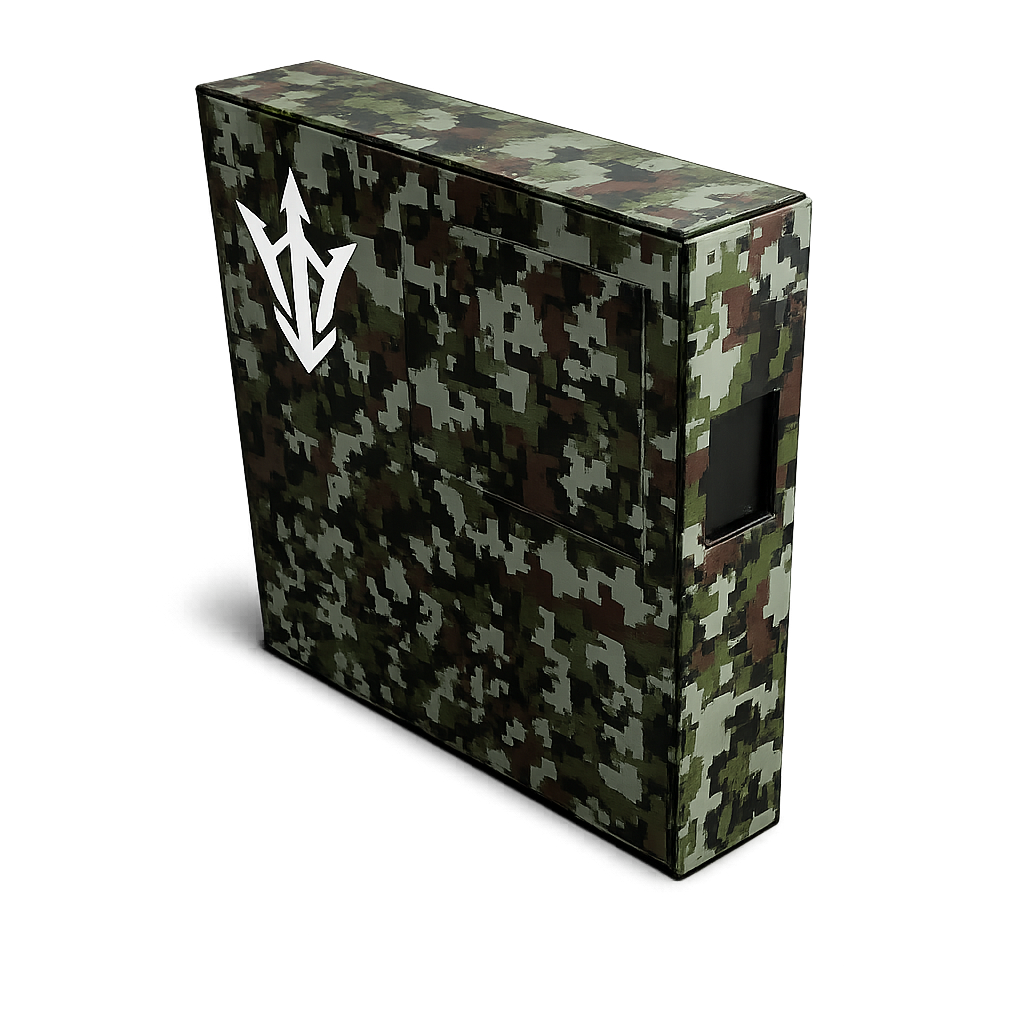
Trident field unit in digital camouflage housing

Triton builds sequencing hardware for places where the lab is too far away or too slow. Trident is for biological sampling in the field. Juno is for clinical sampling in the field.

Trident field unit, a slim upright case in digital camouflage with the trident mark

Trident

Biological sampling for the field.

Sequencing library preparation at the source. No sample transport, sample integrity preserved, and protocols simple enough for operators with varying experience.1

Function
NGS library preparation
Where
At the collection site
Output
Sequencing-ready libraries
Hand-off
Portable sequencing platforms
Request a Trident briefing

How does a Trident deployment run?

A field team at a remote wastewater monitoring site, far from the nearest lab, gets actionable genomic data the same day.2

200km

From the nearest lab in the reference scenario2

Sameday

Actionable genomic data from the field2

0transport

Samples are prepared at the source, not shipped1

  1. 1

    Collect

    Samples collected at the site of interest using standard field protocols.

  2. 2

    Prepare on Trident

    Trident turns them into sequencing-ready libraries in the field.

  3. 3

    Sequence

    Libraries transfer to a portable sequencing platform for immediate analysis.

  4. 4

    Decide

    Genomic insight in hours rather than days.

Where Trident works

Wherever conventional laboratory infrastructure is unavailable or impractical.

Environmental and wastewater surveillance

Pathogen monitoring in water systems at the collection site.

Biosecurity and public health response

On-site genomic analysis during outbreak investigations.

Remote research and field science

Biodiversity and ecological studies in austere environments.

Defense and expeditionary operations

Tactical genomic capability for military and expeditionary medicine.

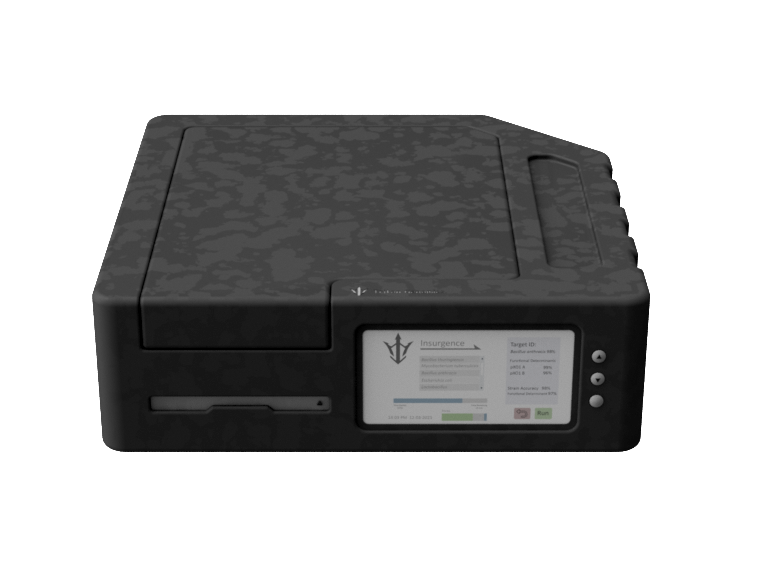
Juno, a compact dark instrument with a cartridge slot and a small touchscreen

Juno

Clinical sampling for the field.

Clinical sample to answer in one closed chassis: lyophilized reagents in the consumable, automated priming, integrated MinION sequencing and on-board classification. A non-expert loads the sample and presses one button.3

To start a full run
One button
Sequencing
Nanopore MinION R10, integrated
Classification
On board
Status
Research Use Only4
Request a Juno briefing

What happens inside the cartridge?

Five steps inside the SALC consumable, closed from sample load to call.3

<46min

Clinical sample to answer3

<5min

Operator hands-on time3

1button

To start a full run3

0cold chain

Lyophilized reagents carried on board3

  1. 1

    Sample

    Plasma, saliva or sputum goes straight in, without measuring or aliquoting.

  2. 2

    Lysis

    Hermetic lysis with lyophilized reagents and no open handling.

  3. 3

    Library

    Automated prep builds DNA and RNA libraries concurrently from one input.

  4. 4

    Sequence

    MinION R10 flow cell with a ten-minute untargeted metagenomic read window.

    Read window 10:00
  5. 5

    Call

    On-board classification with gated detection and a cryptographic trace to the raw reads.

Illustrative run, time compressed

Where Juno works

Field and point-of-need settings where a same-shift answer changes the decision.

Point-of-need clinical ID

Identify the pathogen at the point of need, before empirical therapy decisions harden.

Hospital-adjacent surge capacity

Sequencing outside the central lab during surges or off-hours.

Outbreak response teams

Untargeted clinical metagenomics with no cold chain or instrument stack.

Forward-deployed biosurveillance

Gated, cryptographically traced calls in austere environments.

Juno clinical specifications

Built around clinical sample types, with closed handling throughout.

Validated matrices

MatrixHandlingInput
SputumPrimaryOn-board mucolysis conditioning100 to 300 µL
SalivaPrimaryNon-invasive, point of care or field100 to 400 µL
NasopharyngealPrimarySwab eluate loaded directly100 to 400 µL
Plasma / serumExtensionCirculating nucleic acids
Buffy coatExtensionCell-associated agents

Nominal input 200 µL. Maximum 1,000 µL.3

Biosafety

  • Sealed lysisHermetic seal through the lysis and transfer steps.
  • Internal wasteNo external waste stream. Spent reagents stay inside the consumable.
  • No pipettingClosed fluidics after sample load, with no aerosol risk to the operator.

Research Use Only. Not for use in diagnostic procedures.4

Bring Triton to your operation.

Request a briefing, discuss a pilot, or ask about Trident or Juno for your program.

Email the team info@tritongenomics.com
Inquiries
Pilots, briefings, distribution
Products
Trident, then Juno
Built in
Canada

Notes and sources

  1. Trident capabilities as described by Triton Genomics on tritongenomics.com.
  2. Illustrative deployment scenario described by Triton Genomics: a remote wastewater monitoring site 200 km from the nearest laboratory. Not a record of a specific deployment.
  3. Juno performance, matrix and input figures are Triton Genomics product specifications as published on tritongenomics.com.
  4. Juno is labelled for Research Use Only. See the notice below.